Wednesday, April 25, 2012

Design Banana

Before we continue, let me take a moment to talk about the banana. In the US, CEOs and top managers hate the word “design.” Just believe me. No matter what they tell you, they believe that “design” only has something to do with curtains, wallpaper and maybe their suits. These guys, and they’re still mostly guys, prefer the term “innovation” because it has a masculine, military, engineering, tone to it. Think Six Sigma and you want to salute, right? I’ve tried and tried to explain that design goes way beyond aesthetics. It can have process, metrics all the good hard stuff managers love. But no, I can’t budge this bunch. So I have given up. Innovation, design, technology—I just call it all a banana. Peel that banana back and you find great design. Yummy design. . The kind of design that can change business culture and all of our civil society as well.

Monday, March 5, 2012

Wicked Problems: Problems Worth Solving - Table Of Contents

Table Of Contents

Section One: An Introduction to Wicked Problems

This section first introduces the idea of wicked problems—large-scale social issues that plague humanity, like poverty or malnutrition—and then describes the role of design in mitigating these problems.

Section Two: Skills for the Social Entrepreneur

This section describes the skills designers will need in order to tackle wicked problems effectively.

Section Three: Teaching and Learning

This section describes a model for teaching and learning social entrepreneurship. If you're an educator, the model will help you change an existing curriculum. If you're a practitioner, it will help you structure your own course of study without enrolling in a formal program.

Section Four: Methods

This section contains methods—stand-alone techniques—that you can use as you take on wicked problems from an entrepreneurial perspective. Some of the methods are for conducting research and gaining empathy, while others are for making sense of data and coming up with new ideas. There are also methods for building financial models and worksheets to help you target financial success.

Methods for Conducting Research and Gaining Empathy

Methods for Synthesizing Data and Developing Ideas

Methods for Creating New Designs

Methods for Planning a Business

In Closing

Reference

Monday, January 30, 2012

Massive Health - Carbs Are Killing You [infographic]

Psychology of Persuasion — PsyBlog

Do you want to be an agent of change? Psychological research reveals how to tip the balance in your favour.

All human societies are alive with the battle for influence. Every single day each of us is subject to innumerable persuasion attempts from corporations, interest groups, political parties and other organisations. Each trying to persuade us that their product, idea or innovation is what we should buy, believe in or vote for.

In our personal lives the same struggle is played out for the supremacy of viewpoints, ideals and actions. Whether it's friends and family, work colleagues, potential employers or strangers, each of us has to work out how to bring others around to our own point of view. We all play the influence game, to greater or lesser degrees.

Psychologists have been studying how we try to influence each other for many years. I've been covering some highlights of this research, which are collected below.

1. 3 Universal Goals to Influence People

Effective influence and persuasion isn't just about patter, body language or other techniques, it's also about understanding people's motivations. Central to the art and science of persuasion is understanding three goals for which everyone is aiming. Read on →

2. The Persuasive Power of Swearing

Show your passion and people have one more emotional reason to come around to your point of view. But how can we convince others of our conviction? Light swearing at the start or end of a persuasive speech can help influence an audience. Read on →

3. Loudest Voice = Majority Opinion

Even if only one member of a group repeats their opinion, it is more likely to be seen by others as representative of the whole group.

Read on →

4. Don't Take No For An Answer

You ask someone for a favour and they say no. Where do you go from there? Dealing effectively with objections can be more powerful than other standard methods of persuasion.

Read on →
5. The Influence of Fleeting Attraction

Friendship is a fantastic lever for persuasion and influence, a lever we happily push on every day. But how much does someone have to like us before we can start to influence them?

Read on →

6. Caffeine Makes Us Easier to Persuade

Of all the effects caffeine has on our minds—enhanced attention, vigilance and cognition—perhaps least known is its tendency to make us more susceptible to persuasion.

Read on →

7. Persuasion: The Right-Ear Advantage

fingers in ears

If you want someone to comply with a random request for a cigarette, you should speak into their right ear.

Read on →
8. Balanced Arguments Are More Persuasive

The instinct to paper over weaknesses in our argument is wrong—so long as we counter criticism.

Read on →

9. The Battle Between Thoughts and Emotions in Persuasion

Nowadays people tend to use 'I think' and 'I feel' interchangeably. Does it make any difference whether what you say is couched in 'thinking' or 'feeling' terms?

Read on →
10. Our Secret Attitude Changes

When you change your attitude about something, do you know why? Psychologists have argued that the inner workings of our minds are largely hidden away from us. One aspect of this is the surprising finding that people are often unaware when they have changed their attitudes. Read on →

11. Are Fast Talkers More Persuasive?

Beware the fast-talker, the person with the gift of the gab—the friendly salesman, the oily politician—running through the 'facts' faster than you can keep up.

Read on →

12. Persuasion: The Sleeper Effect

Any time we receive a persuasive message before we find out who the source is, the sleeper effect can come into play.

Read on →

13. Communicating Persuasively: Email or Face-to-Face?

Face-to-face communication is usually most persuasive but it's not always possible to meet in person. How, then, do people react to persuasion attempts over email?

Read on →

14. The Influence of Positive Framing

Do people really pay more attention to frightening messages? Actually emphasising the positive can be more persuasive than pointing out the negative. Read on →
15. The Illusion of Truth

Repetition is used everywhere: advertising, politics and the media. It seems too simplistic that just repeating a persuasive message should increase its effect, but that's exactly what psychological research finds (again and again). Read on →
16. 9 Propaganda Techniques in Michael Moore’s Fahrenheit 9/11

Back in the Summer of 2004 Michael Moore brought out 'Fahrenheit 9/11', his personal view of how terrorist attacks in the US were used to pursue illegal wars. This article examines the psychological techniques of persuasion used in that film. Read on →

17. Persuasion: The Third-Person Effect

Attractive woman holding a bottle of beer? Hah! How stupid do they think we are? Many people say that persuasion attempts have little or no effect on them. Other people, oh sure, adverts, work on them. But not you and I, we're too clever for that.

Read on →
18. 20 Simple Steps to the Perfect Persuasive Message

Perfection is hard to achieve in any walk of life and persuasion is no different. It relies on many things going just right at the crucial moment; the perfect synchronisation of source, message and audience. But even if perfection is unlikely, we all need to know what to aim for. Read on →

Image credit: Martin Howard
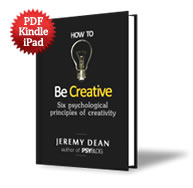
How to Be Creative


If we can all be creative, why is it so hard to come up with truly original ideas?

It's because creativity is mysterious. Just ask any scientist, artist, writer or other highly creative person to explain how they come up with brilliant ideas and, if they're honest, they don't really know.

But over the decades psychologists have given ordinary participants countless tests, forms and tasks and conducted hundreds of hours of interviews. From these emerge the psychological conditions of creativity.

Not what you should do, but how you should be...

Click here to find out more...

Published: 4 January 2011

What Dr. Smartphone Can Do For You | Fast Company

Media_httpimagesfastc_ejtbs

An interesting visualization of health technologies!

Monday, November 28, 2011

projeqt \ how great stories are told

Media_httpprojeqtcoma_kslfd

Looks interesting

Friday, September 2, 2011

Does quantifying data about self lead to behavior change?

There is a notion that if people are given access to information, they will make a different (read: better) choice. This has lead to numerous services tracking various aspects of one's life.

I believe that behavior is largely resistant to change. We all already know the information that these services are providing us - to lose weight one needs to expend more calories than one consumes; to save money one needs to earn more than they spend. Yet, when I open the refrigerator I am more likely to reach out for the black forest cake rather than the plums!

This month is going to be an experiment in understanding some of these services that I have signed up for (but never really paid attention to) and trying to design a better feedback loop for my goals.

Here are the five goals I want to achieve (based on some of my previous new years resolutions):

1. Food (body): Eat breakfast everyday and drink more water
2. Exercise (body/soul): Some form of physical activity every day of the week
3. Finance (mind): Save money for buying a new bike
4. Work (mind): Evolving an idea to a prototype that I can show to people
5. Soul: Taking time out to meditate and introspect

Some of the services I have tried to use before (and am looking for better alternatives):

1. Food: LoseIt!
2. Exercise: Fitbit, Nike+
3. Money: Mint, BillShrink
4. Work: iLife
5. Soul: --

As I map my journey, writing about the past (why I stopped using some of these services), present (different ways to visualize my daily experiences), and future (what opportunities lie in this space of "quantified self"); I urge you all to tell me about your experience with trying to make a change!

I was going to end with the cliche quote - "Be the change you want to see in the world" but instead I'm going to use this one from Socrates - "The unexamined life is not worth living."

Wednesday, November 3, 2010

Kigali - first few days! No first impressions yet!

Finally, I am back in Africa. After a passport/FedEx mishap and rebooking flights, I arrived in Kigali a couple of days ago. The 30 hour long was definitely one of the most tiring ones that I have made till now, and I was surprised in Brussels that the terminal for Africa was in the middle of nowhere. It was great to walk out the airport to Elizabeth jumping and waving. :)

I am living at Shirley's - a professor in gender studies who is setting up the school for gender, culture, and development (?) at KIE (Kigali Institute of Education). There are three other girls here, along with Elizabeth and I, and I am hoping to write about what brings them to Rwanda eventually. Shirley's house is a luxury that I was not expecting - water heater for the shower, washing machine for clothes, and a help who makes us meals. And most importantly, wifi that works (although it can be rather slow especially with all of us trying to use it at the same time!)

Yesterday was our first face-to-face SHE team meeting. Julian came over to the SHE Headquarters, which is currently the patio at Shirley's. It was great meeting Julian in person after the numerous emails and skype calls exchanged. She is our local expert, and we spent the afternoon planning the rest of my trip, people I should meet and places I should visit. I am excited about what she has come up with and am looking forward to start my adventure.

I spent the morning going over the research plan again with E and J, identifying the people we need appointments with, and trying to plan the days we would visit them. I also started looking at questions to ask them, and preparing research tools for these individuals or groups. Post-lunch I took a little trip with E first to KIE, and then went to the bank to exchange some currency and buy myself a local sim card. This little trip alone made me realize that I should have brushed up my french before coming here. Last night while we were out for dinner I could not remember what the word for "food" was!

I haven't really been out and about to have any first impressions yet. My interaction with people has been limited to ordering brochettes (kababs), buying a sim card, and buying some meat for our barbeque tomorrow night. Tomorrow I will be visiting the city center and markets around and hopefully will have something to say.

The only thought till then is about how much this place reminds me of Ooty. Although it's certainly warmer, the hills around and the narrow roads and houses make me miss Charing Cross and the big moustached traffic police man!

P.S. It was taking too long to upload pictures so I'll add those later.

Sunday, July 18, 2010

Samarth Bicycle Trailer at the Cooper Hewitt

It's been a while since I blogged and now it's time to play catch up. To start with, some great news. I was in New York in May for the opening of the National Design Triennial WHY DESIGN NOW at the Cooper Hewitt where one of my projects was being displayed. I am currently thinking about how to take this from prototype to product to venture. Any insights?

Tuesday, September 1, 2009

More thoughts on MOMI

About 100,000 Indian women die every year due to lack of skilled care during pregnancy.


Monday, August 31, 2009

A project on Water

I wanted to do a project on Women and Water and so I spent this summer trying to figure out what would be the best thing to do. When I first googled the topic, I was swamped with information. But not all this information was relevant. And there were many things that I needed to know that I could not find (or took very long to find). One thing I realized was that a lot of research has been done on safe clean drinking water. There are a lot of products and systems out there tackling the issue, but there is no one place to get all this information. And thus I took it upon myself to create a portal where one could find a way to implement projects related to water, sanitation, and hygiene specific to a certain geographic area. Below, is my final presentation for the same.


Water Presentation

After visiting the different villages in Africa over the summer, and now Chhattisgarh over the last few days, I found that most villages had access to a borewell and clean drinking water. But this water got contaminated in its journey from this source to the individual household. The jerrycans or pots that were used to fill water were pretty dirty, the women and children collecting the water did not wash their hands, and the same hand went into the pot while carrying the water, transporting this heavy load from Point A to B was a nightmare. And these were just stored out in the open with nothing to cover and protect this valuable source from insects and other contaminants. I see an opportunity for a well designed storage-cum-transportation device. And while many people have tried to address this issue (Q-drum, hippo roller, etc.) I did not really see anyone is the villages using these products. For some reason, they seem to unfamiliar in the current landscape of things. I believe here lies a great design opportunity.

momi

A project I did this summer before leaving for Ghana, momi stands for MIDWIFERY AND OBSTETRICS FOR MOTHERS AND INFANTS.

Rural areas lacks access to public healthcare and the distribution channels for medicines and services is limited, leading to increased mortality and many diseases going untreated. The decision to acquire treatment is based on the cost to travel to the clinic or hospital: if it results in more money spent in transportation or wages lost due to the time taken to reach the facility, people will defer treatment until the condition is relatively serious. This ineffective system results in self-medication techniques, making pharmacies or other sources of medicines the most important part of the healthcare system. This shows a huge need not only for the distribution of medicines to remote areas, but also a requirement for health education so that rural households know the best way to treat their symptoms.

When it comes to women, more than 50% of the death rate is dur to childbirth. At the same time, the biggest cause of high Infant Mortality Rates in the developing world is due to lack of neonatal care. The goal of this project is to ensure that midwife's in rural India have the education and the
infrastructure required for childbirth. India's Infant Mortality Rate is one of the highest in the world, and the IMR in rural areas is much greater than urban areas. This project wants to address the challenges of childbirth and maternal health education in rural India.

The solution is a system where traditional midwives are trained for a month at nearby Primary Health Centers on how to use basic instruments during childbirth. At the end of this training module, they are given a child delivery bag that contains a stethoscope, sphygmomanometer, surgical handle + blades, surgical gloves, cotton yarn, and ivory soap.

Along with these, they are given two subkits - one for the mother and one for the infant. The mother's kit consists of a towel for her to lay down on, a muslin sheet to cover her at the time of delivery, and a washcloth to keep her clean. The infant's kit contains a cotton shirt and a cap for the newborn to wear, and a receiving blanket to wrap him/her in.

Below are some pictures of the Mother's kit and Infant's kit.


This was my first time working with packaging and branding and some of the graphics turned out to be too (sexy???) But after visiting the Primary Health Center in a village (Kenochi) in Chhattisgarh and speaking to a midwife in a nearby village (Amadov), I am ready to go back and redesign some of the graphic elements, as well as build the system further based on their input!

Friday, March 27, 2009

More Post_Its!


Presentation Ideas - My Thoughts So Far!


I created this email as an update for my Independent Study instructors. It's more like my thoughts on how I'm going to present all the research I've been doing this term to help me pick out options for my final thesis project. Take a look and I want all your questions/comments. 

1. THESIS STATEMENT
I still need to come up with one specific design challenge which should be framed in human terms. It should be broad enough to allow me to discover areas of unexpected value while narrow enough to make the topic manageable. I am thinking something that combines the biggest problem that rural India faces and that is "how to increase their income" along with empowering women by making them an integral part of the solution. SO maybe something like "How can one change the role of women in the rural society to help increase the family's income?"

2. BACKGROUND
A little background on India, rural India, agrarian economy and women. A lot of this would be statistics and graphs.

3. TRENDS - What relevant trends are creating new needs?
I have identified 5 major trends that I would like to elaborate on:
(a) Population Growth and Migration
(b) People's Increasing Expectations
(c) Internet/Mobile Penetration
(d) Emerging Technologies
(e) Economic Instability and Upheaval

4. THEMES - What needs should do the project address?
While there are many paths that one can take, there are five themes that I would like to explore:
(a) Sustaining Resources
(b) Managing/Providing Information
(c) Empowering Community/Women
(d) Integrating Functions and Services
(e) Maximizing Efficiency and Self-sufficiency

5. ISSUES - What are some of the key issues involved?
The key components of the rural society are:
(a) Food
(b) Energy
(c) Health
(d) Transportation
(e) Agricultural Inputs
(f) Household Goods
(g) Education
(h) Information and Communication Technologies
(i) Water
(j) Housing

6. CHALLENGES - What insights can be gained about why things go right or wrong?
For each of the above areas, understanding how things are right now, what are the challenges, and how can they be improved.

7. OPPORTUNITIES - What ideas can be generated to take advantage of these insights?
For each of the above areas, the solutions that have worked and how they can be adapted to the rural Indian scenario.

8. STRATEGIES - What position should the project take on the issues?
Based on the themes, what are the main components of the solution:
(a) Involve the rural community in the design process
(b) Create a solution that is customizable to different needs
(c) Women - teach them to start and maintain the solution
(d) Use emerging technologies as a facilitator for local manufacturing
(e) Opportunities for empowerment instead of dependence to create a sustainable solution

9. FEATURES - What functions make the solution work?
What are the different features for each of the strategies above?

10. SOLUTIONS - What functions are related to create potential solutions?
Based on the strategies, refine the different opportunities to create comprehensive solutions.

11. SYSTEM - What functions should we look at together to create a more systemic solution?
How many of these solutions can be paired together to create a valuable ecosystem?

12. FINAL PROJECT
Present atleast three potential options for a final project!

Tuesday, March 3, 2009

Featured on KCET